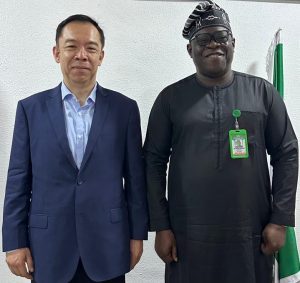
- IMION Director-General, Rear Admiral Thaddeus Udofia (rtd), presenting a certificate to one of the IMION executive course participants from the Nigerian Immigration Service, Mr Augustus Maisor. IMION said discussions were ongoing to partner the Admiralty University of Nigeria on future certifications for wider relevance.
By Anthony Nwachukwu
The International Maritime Institute of Nigeria (IMION) has disclosed an ongoing engagement with the Admiralty University of Nigeria to issue certificates for its executive course programmes.
Disclosing this virtually on Wednesday at the closing ceremony of the IMION three-day executive course on “Logistics and Trade Facilitation for the Blue Economy,” which was held in Lagos, a board member, Mrs Mfom Usoro, said the IMION Director-General, Rear Admiral Thaddeus Udofia (rtd), was also discussing with some other institutes in that direction.
According to her, “given the depth of the courses and the analysis, IMION wants to make the certificates useful in the job market, not just for those of you that are already bigger guys, but for the upcoming ones, such that it will be a certificate that will work towards their promotion and also get them admission into other qualifying courses. So, very soon, we will announce that.”
Further commending the participants for their dedication to their group assignment during the course, Usoro said, “What IMION is doing is not merely academic; we are bringing it home to practical situations.”
Meanwhile, the IMION Director-General, Udofia, has charged participants to put their learning to work, stating that “the knowledge acquired through the programme will only have its full value if it translates into action.”
Calling for a coordinated action, IMION said “the blue economy is not a distant economic frontier” but was already happening and “accounts for the majority of global seaborne trade and holds the key to Nigeria’s economic development, particularly in the areas of industrialisation, job creation, regional integration, and other frameworks like the African Continental Free Trade Area (AfCFTA).”
Udofia noted that regardless of the challenges, efficiency remains “the currency of modern global trade. If our transit times remain uncompetitive, logistics costs continue to be prohibitive, and our processes lack transparency and integrated digitalisation, cargo will bypass our corridors for other regional hubs.”
Also, “the cost of goods and services would remain prohibitively elevated, thereby further impoverishing our city’s living and stifling our national economic development.”
Therefore, “changing these stark narratives requires synchronised data agency execution among the customs, port authorities, security operators, investors, regulators, and private logistics operators.
“You, our participants seated here, are the bridge builders of this necessary collaboration. As you return to your respective duties, do not leave the insights from this course in your notebooks.”
He charged them to “be the change agents who advocate for data sharing and digital transparency” in their organisations; “boost practical reforms that reduce transaction friction at our ports and the entire logistics and trade value chain,” and “translate the strategies made into actionable policies that lower the cost of doing business in Nigeria.”