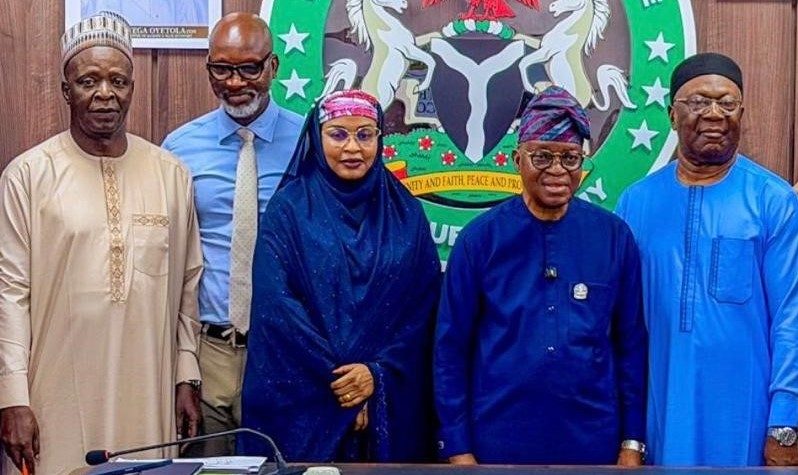
Director, Federal Department of Fisheries and Aquaculture, Lagos Office, Garba Usman (left), Senior Special Assistant to the President on Marine and Blue Economy, Prof. Busayo Fakinlede, Permanent Secretary, Federal Ministry of Marine and Blue Economy, Fatima Mahmood, the Minister, Adegboyega Oyetola, and the Director, Federal Department of Fisheries and Aquaculture, Abuja, Omoragbon Wellington, during the minister’s inauguration of the Technical Committee on Accelerating Fish Production in Nigeria, in Abuja
By Chidubem Anthony
All eyes are now on the federal government’s Technical Committee on Accelerating Fish Production in Nigeria to translate recommendations in the sector into concrete action and boost the country’s fish production.
To turn around the nation’s fortunes in this sector, Oyetola tasked the committee with addressing the identified constraints, including high production costs, particularly the cost of feed; inadequate access to quality fish seed and broodstock; and weak fish-health and biosecurity systems.
Other challenges include post-harvest losses, insufficient cold chain and storage infrastructure, limited access to affordable finance, gaps in research and innovation, weak data systems, and inadequate standards, traceability, and market development.
Inaugurating the committee in Abuja on Thursday, the Minister of Marine and Blue Economy, Dr. Adegboyega Oyetola, said the aim was to move beyond policy recommendations to coordinated action capable of delivering measurable improvements in the country’s fisheries and aquaculture sector.
He noted that “fish is an important source of animal protein for millions of Nigerians,” while the “fisheries and aquaculture sector sustains livelihoods across production, processing, marketing, transportation and related services.
Unfortunately, “domestic production has remained substantially below national demand, with consequences for food security, household incomes and foreign-exchange resources,” his Special Adviser, Dr Bolaji Akinola, cited the minister to say.
Oyetola said the transfer of fisheries and aquaculture functions to the ministry has provided a stronger institutional platform for addressing the identified challenges as part of Nigeria’s broader blue-economy development.
Therefore, he reaffirmed the ministry’s commitment to increasing sustainable domestic fish production, strengthening the fisheries value chain and progressively reducing Nigeria’s dependence on fish imports.
He charged the committee, chaired by the Permanent Secretary of the ministry, Mrs Fatima Mahmood, to rigorously assess those recommendations, refine, where necessary, integrate into existing frameworks or set aside where unviable, and turn validated proposals into a practical, prioritised implementation roadmap.
He stressed that “the report of the roundtable must be assessed against the National Policy on Marine and Blue Economy, the National Fisheries and Aquaculture Policy, relevant laws, existing government programmes and the statutory mandates of relevant institutions.
Among others, the “final output should include a clear implementation roadmap and matrix setting out the priority interventions, responsible institutions, timelines, indicative costs, funding options, performance indicators and required approvals.
“It should also identify credible opportunities for private-sector investment, public-private partnerships, development finance and other sustainable funding arrangements,” he said.
Meanwhile, the Permanent Secretary of the ministry and Chairman of the committee, Mrs Fatima Mahmood, assured that the committee would approach its mandate with a strong sense of responsibility, working with relevant institutions, partners and stakeholders.
The members of the committee include the Director, Federal Department of Fisheries and Aquaculture, Abuja, Omoragbon Wellington; Director, Federal Department of Fisheries and Aquaculture, Lagos Office, Garba Usman; and the Executive Director, Nigerian Institute for Oceanography and Marine Research, Prof. Sule Abiodun.